History
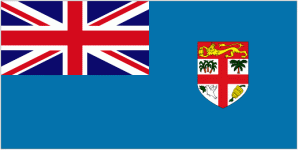
The Fiji men's national football team (Fijian: timi ni soka ni Viti) represents Fiji in international men's association football. It is controlled by the governing body of football in Fiji, the Fiji Football Association. The team plays most of their home games at the HFC Bank Stadium in Suva.
Fiji first participated in the FIFA World Cup qualification in 1982; since 1990, Fiji have attempted to qualify for each World Cup without success. Their best result was a final round appearance in 2010. The national team also represents Fiji at the OFC Nations Cup, having appeared in nine out of eleven previous tournaments. Fiji's best result is a third-place finish at the 1998 and 2008 editions. They have won the Melanesia Cup five times and competed in the Pacific Games from 1963 until 2015 when the competition became an under-23 tournament.
As in most countries in Oceania where football (or soccer) is not the most popular sport (such as Australia and New Zealand), Fiji's most popular sport is rugby union. As of 2026, Fiji has never qualified for the FIFA World Cup. In spite of this, the country's youth football team has enjoyed recent success, qualifying for both the 2015 and 2023 FIFA U-20 World Cups and the 2016 Olympic football tournaments.
Read the full history
Beginnings (1951–1973)
Fiji's first international football game was against a New Zealand side that was touring Oceania and had played four games against New Caledonia. The international, which took place on 7 October 1951, saw New Zealand getting the win 6-4. Jock Newall got a hat-trick for New Zealand. New Zealand returned the following year, with Fiji losing all three games, including a 9–0 drubbing in the second match.
After being absent from the international game for eleven years, the Fiji Football Association joined FIFA in 1963. That same year, the national team entered the first edition of the South Pacific Games, held in Fiji. In that tournament, the country appeared in its first gold medal match after defeating Papua New Guinea and the Solomon Islands, but lost the match to New Caledonia 8–2. Marc-Kanyan Case scored four goals for the opposition and Fiji was relegated to silver.
After missing 1966, the team's next tournament appearance was in the 1969 Games held in Port Moresby, Papua New Guinea. They finished in fourth place out of six teams after losing to Papua New Guinea in the bronze medal playoff. Two years later, Fiji finished at the bottom of Group two with losses against New Caledonia and New Hebrides. They would, however, defeat the Cook Islands in the fifth place play-off.
World Cup qualifying debut and Oceania upsets (1973–1991)
As a member of the Oceania Football Confederation, Fiji played in the first edition of the OFC Nations Cup held in New Zealand in 1973. They did not win a match in the four games they played during the tournament. Competing at the 1975 South Pacific Games the national team, under coach Sashi Mahendra Singh, made the semi-finals of the competition where they lost to Tahiti. In the third-place playoff, they lost to the Solomon Islands by a goal.
After John Lal became the new coach for Fiji in 1977, his first match as coach was an unofficial game against Taiwan which ended in a two-all draw before taking on Australia who played Taiwan because of the soccer ban in the country. On 19 March 1977, they took on Australia at Buckhurst Park. Seven national players from Ba F.C. were unavailable due to a planned tour of New Zealand. After holding off the Australians for the first forty-five minutes, Jimmy Okete (who was making his debut) scored the only goal of the game. This was a shock to the locals since the team struggled in the two tours to Australia in 1961 and 1968 against the state teams.
Under the orders of new coach, Moti Musadilal, they played some pre-tournament friendlies against New Zealand conceding nine goals in the two games before competing at the 1979 South Pacific Games in Suva. After getting a nil all draw against Papua New Guinea, they scored their biggest win against Kiribati winning by twenty-four goals. After defeating Wallis and Futuna in the quarter-finals and Solomon Islands in the semis, they made it to their second Pacific Games final against Tahiti. In front of over twenty thousand people, Fiji came up short again with Erroll Bennett scoring a double to give Tahiti the gold medal.
Fiji's next tournament was the 1980 OFC Nations Cup where they were grouped with New Zealand, Solomon Islands and Tahiti. After defeating the Solomon Islands in the opening game, they were expected to lose against New Zealand who were the favourites to win the group. On 27 February 1980, they became the first Fijian team to defeat a New Zealand team with Dewan Chand and Meli Vuilabasa both scoring two goals in the victory. Fiji did not make it to the final. They lost first to Tahiti 6–3, and then lost the third-place playoff to New Caledonia 2–1, in what was the last Oceania Cup for sixteen years.
The following year saw a new coach with former New Zealand coach Wally Hughes leading the team into their first World Cup qualifiers. After opening with a four-goal defeat against New Zealand, they drew with Indonesia nil-all, before defeating Chinese Taipei 2–1 to be in third place with three points. For Fiji that momentum was short-lived. They finished at the bottom of the group after conceding twenty-three goals in the final two games against Australia and New Zealand. Hughes resigned after the Australian game stating, "I wouldn't wish on any coach what I have been through," suggesting that bribery was involved in the defeat to Australia.
After two years absence from international football, the national team, under Rudi Gutendorf, competed at the 1983 South Pacific Games in Samoa. After finishing top of the group that featured New Caledonia, Solomon Islands and Vanuatu, they defeated Papua New Guinea 2–0 in the quarter-finals before knocking off New Caledonia in the semi-final. In the final, they lost to Tahiti by a single goal which was contested by the players who attacked the referee and linesmen. Another similar incident in a friendly against New Zealand happened the following year. This led to a one-year ban of international matches being held at Fiji.
Fiji's next tournament was the 1988 Melanesia Cup held in the Solomon Islands. The national team won the final against the Solomon Islands 3–1 to claim their first title. Later in that year, they competed in the first round of the 1990 FIFA World Cup qualification against Australia, with the motivation of five hundred Fijian dollars bonus for each player if they won. In front of six thousand people, they defeated Australia 1–0 with Ravuame Madigi scoring the goal to take the lead heading into the second leg. The second leg though saw Australia take out the match by a score of 5–1 in what media called the "Battle of Newcastle". It included an all-in brawl in the last part of the match which saw Charlie Yankos get a broken nose.
Read more on Wikipedia →
Text from Wikipedia, licensed CC BY-SA 4.0
Squad
| # | Goalkeepers | Apps | Goals |
|---|---|---|---|
| 1 | M. Waqali | ||
| 21 | E. Esposito | ||
| S. Tikoisuva | |||
| M. Tinaimakubuna | |||
| S. Vasuitoga | |||
| K. Scott |
| # | Defenders | Apps | Goals |
|---|---|---|---|
| 2 | E. Mereia | ||
| 5 | C. Qalivere | ||
| 11 | S. Naweni | ||
| 19 | A. Rekha | ||
| A. Sorovakarua | |||
| A. Hussein | |||
| V. Ranadi | |||
| F. Racea | |||
| N. Waqanidrola | |||
| M. Veronika | |||
| A. Volitikoro | |||
| U. Tuberi |
| # | Midfielders | Apps | Goals |
|---|---|---|---|
| 3 | A. Bakaniceva | ||
| 8 | P. Singh | ||
| 12 | P. Kilaiwaca | ||
| 16 | E. Buka | ||
| S. Diyalowai | |||
| C. Nasau | |||
| J. Tabua | |||
| T. Vuniyayawa | |||
| K. Likuculacula | |||
| M. Tora | |||
| V. Kumar | |||
| A. Dwarka | |||
| I. Nai | |||
| S. Sindhika | |||
| V. Riwai | |||
| M. Ofakimalino |
| # | Forwards | Apps | Goals |
|---|---|---|---|
| 7 | K. Tabua | ||
| 9 | N. Leba | ||
| 10 | E. Tabunase | ||
| L. Tamanitoakula | |||
| A. Reva | |||
| T. Davis |