History
The Lebanon national football team (Arabic: منتخب لبنان لكرة القدم) represents Lebanon in men's international association football and is governed by the Lebanese Football Association (LFA). Founded in 1933 as one of the first football governing bodies in the Middle East, the LFA has been a member of FIFA since 1936 and the Asian Football Confederation (AFC) since 1964.
Lebanon have never qualified for the FIFA World Cup, but reached the final round of Asian qualification for the 2014 and 2022 tournaments. The team have participated in the AFC Asian Cup three times, first as hosts in 2000 and subsequently in 2019 and 2023. At the 2019 tournament, Lebanon recorded their first Asian Cup victory, defeating North Korea 4–1, but were eliminated in the group stage on the fair play rule. They have also competed in regional tournaments, including the Arab Cup, the WAFF Championship, and the Arab Games.
Lebanon played their first FIFA-recognised international match against Mandatory Palestine in 1940. They regularly participated in regional competitions during the 1950s and 1960s, finishing third at the 1957 Arab Games and the 1963 and 1964 Arab Cups. The Lebanese Civil War disrupted the team's activities between 1975 and 1990, leading to withdrawals from several international competitions. After the war, Lebanon returned to more regular international play, finishing third at the 1997 Arab Games and hosting the 2000 Asian Cup.
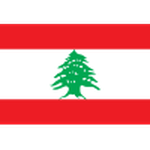
The team is nicknamed "the Cedars" (Arabic: رجال الأرز), after the cedar of Lebanon, the country's national symbol. Their traditional home kit is predominantly red, while their away kit is usually white, reflecting the colours of the Lebanese flag. The team plays their home matches at various stadiums across the country, most notably the Camille Chamoun Sports City Stadium in Beirut. Lebanon reached their highest FIFA World Ranking of 77th in September 2018, during a 16-match unbeaten run. Hassan Maatouk holds the national records for both appearances and goals, having made 123 appearances and scored 26 goals.
Read the full history
1933–1947: Formation and early matches
Lebanon was one of the first nations in the Middle East to establish a formal administrative body for association football. On 22 March 1933, representatives from 13 football clubs gathered in the Minet El Hosn district of Beirut to form the Lebanese Football Association (LFA). The LFA was initially led by Hussein Sejaan, and became a member of FIFA in 1936.
On 3 February 1934, the LFA organized a training camp for 22 players from Beirut in preparation for a friendly match against the Romanian club CA Timișoara (TAC). The players were divided into two teams and competed against each other at the American University of Beirut (AUB) field. However, the scheduled match against TAC on 18 February was cancelled due to financial disputes between the LFA and AUB, which had organized the event. The Beirut XI team eventually faced TAC on 21 November 1935 at the AUB field, losing 3–0.
On 29 October 1939, the Beirut XI played their first match against Syria's Damascus XI in Beirut, resulting in a 5–4 defeat. They played a return game in Damascus on 14 November, which resulted in a 6–1 win for Beirut XI. Over the following years, the two teams competed in 16 unofficial matches until 1963, with the Beirut XI securing seven victories, two draws, and seven losses.
The Lebanese national team's first official FIFA-recognized match was played on 27 April 1940, facing Mandatory Palestine at the Maccabiah Stadium in Palestine. The game ended in a 5–1 defeat for Lebanon, with an estimated attendance of 6,000 to 10,000 spectators. Mandatory Palestine dominated the first half, scoring four goals. In the second half, Lebanese forward Camille Cordahi, assisted by Muhieddine Jaroudi, scored Lebanon's first official international goal. Mandatory Palestine added a fifth goal, concluding the match with a 5–1 victory.
Lebanon played their first official match against Syria on 26 April 1942, losing 2–1 in Beirut as part of the Coupe Hauteclocque. The trophy, donated by French diplomat Jean de Hauteclocque in 1939, was intended to be a regular fixture between Lebanon and Syria. The match, held at the AUB field in front of 3,000 spectators, saw Lebanon coached by Abed Traboulsi and captained by Labib Majdalani. Although two matches were initially planned, only the Beirut fixture took place. The Coupe Hauteclocque remained a point of contention, as the Syrian Football Association had retained possession of the cup since 1939. Lebanon played two additional friendlies against Syria in 1947, losing 4–1 in Beirut on 4 May, and 1–0 in Aleppo on 18 May.
1953–1963: Early international tournaments
Coached by Vinzenz Dittrich, Lebanon participated in their first international tournament at the inaugural edition of the football tournament at the Arab Games, held in Egypt in August 1953. The team finished at the bottom of its group after a 4–1 loss to Jordan, and a 0–0 draw with Syria. In the fifth-place match, Lebanon secured a 9–1 victory over Palestine.
In February 1956, Lebanon played Hungary in a notable 4–1 home defeat, during which Hungarian star Ferenc Puskás scored two goals. Lebanon also participated in unofficial matches against prominent European clubs such as Dynamo Moscow, Leipzig, and Spartak Trnava in 1957. That same year, Lebanon faced Romanian club Energia Flacăra Ploiești in the opening game of the Sports City Stadium in Beirut, securing a 1–0 victory with a goal by Joseph Abou Mrad.
In October 1957, Lebanon hosted the second edition of the Arab Games and were drawn with Saudi Arabia, Syria, and Jordan in the group stages. After two 1–1 draws against Saudi Arabia and Syria, Lebanon defeated Jordan 6–3 thanks to two braces by Joseph Abou Mrad and Mardik Tchaparian, and one goal each by Robert Chehade and Levon Altounian; this placed them first in their group. In the semifinals, Lebanon lost 4–2 to Tunisia. They finished in third place after Morocco withdrew from the third-place match.
Lebanon hosted the third edition of the Mediterranean Games in 1959, held in Beirut in October, and were grouped with Italy B and Turkey B. They finished last in the group, after four losses to the two European teams. Lebanon played their first Olympic Games qualifiers in 1959 between November and December. Coached by English coach Harry Wright, Lebanon were grouped with Iraq and Turkey. They played two games against Iraq, losing 3–0 at home and 8–0 away, before withdrawing from the qualifiers prior to their two matches against Turkey.
The 1961 Arab Games, the third edition of the competition, were held in Morocco between August and September. The tournament featured six teams competing in a single round-robin format. Lebanon participated under head coach Joseph Nalbandian. Lebanon began the tournament with defeats to Libya (3–2) and the United Arab Republic (UAR; 4–0). The team then defeated Kuwait (4–0), before losing to Morocco (1–0). Lebanon concluded the tournament with a victory over Saudi Arabia (7–1), finishing in fourth place.
Read more on Wikipedia →
Text from Wikipedia, licensed CC BY-SA 4.0
Squad
| # | Goalkeepers | Apps | Goals |
|---|---|---|---|
| 1 | Mehdi Khalil | ||
| 21 | Mostafa Matar | ||
| 23 | Ali Al Sabaa |
| # | Defenders | Apps | Goals |
|---|---|---|---|
| 2 | Mohammad Al Hayek | ||
| 2 | Ali Alredha Ismail | ||
| 3 | Khalil Khamis | ||
| 3 | J. Smaira | ||
| 5 | Nassar Nassar | ||
| 6 | Hussein Al Zein | ||
| 12 | Hasan Srour | ||
| 17 | Khalil Bader | ||
| 18 | Kassem Al Zein | ||
| 22 | Hasan Farhat | ||
| J. Gabriel |
| # | Midfielders | Apps | Goals |
|---|---|---|---|
| 2 | A. El Fadl | ||
| 4 | P. Budib | ||
| 7 | Mahmoud Zbib | ||
| 8 | Sisi | ||
| 13 | Ahmad Khairdien | ||
| 14 | Gabriel Bitar | ||
| 16 | Waleed Shour | ||
| 17 | Ali Al Haj | ||
| B. Kawam |
| # | Forwards | Apps | Goals |
|---|---|---|---|
| 7 | K. Darwiche | ||
| 9 | Omar Bugiel | ||
| 10 | Mohamad Haidar | ||
| 11 | A. Kassas | ||
| 11 | L. Farah Shahin | ||
| 15 | Jihad Ayoub | ||
| 17 | H. Chakroun | ||
| 19 | A. Ayoubi | ||
| 20 | J. Kazan | ||
| 20 | S. Merheg | ||
| W. Fawaz | |||
| H. Kaafarani | |||
| R. Khoury |