History
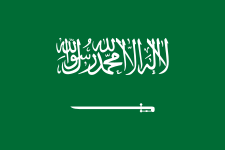
The Saudi Arabia national football team (Arabic: مُنْتَخَب السُّعُودِيَّة لِكُرَّةِ الْقَدَم) represents the country in senior men's international association football. The team is governed by the Saudi Arabian Football Federation (SAFF), the governing body for football in Saudi Arabia.
Considered one of Asia's most successful national teams, Saudi Arabia has won the AFC Asian Cup three times (1984, 1988, and 1996), reached a joint record six Asian Cup finals and have qualified for the FIFA World Cup on seven occasions since debuting at the 1994 tournament. Saudi Arabia is the first Asian team to reach the final of a senior FIFA competition at the 1992 King Fahd Cup, which would eventually become the FIFA Confederations Cup. Only Australia and Japan managed to repeat this feat in 1997 and 2001, respectively, though Australia achieved it when they were a member of the OFC.
At the 1994 FIFA World Cup, under the leadership of Jorge Solari, Saudi Arabia beat both Belgium and Morocco in the group stage before falling to Sweden in the round of 16. Thus, they became the second Arab team in history to reach the knockout stage of a FIFA World Cup after Morocco in 1986 and 2022, and one of the few Asian national football teams (the others being Australia, Japan, South Korea, and North Korea) to accomplish such a feat to date. During the 2022 FIFA World Cup, Saudi Arabia caused a significant upset when they beat eventual champions Argentina 2–1, the first time Argentina lost to an Asian representative at the World Cup. However, Saudi Arabia then lost the following matches against Poland and Mexico to finish last.
In 2027, Saudi Arabia will host the AFC Asian Cup, the first time that the nation has ever hosted a major international tournament. They will also host the 2034 FIFA World Cup.
Read the full history
Early history (1951–1955)
The idea of a Saudi national team first emerged in 1951, when a Saudi XI team, consisting of players from Al-Wehda and Al-Ahli took part in a friendly game against the Egyptian Ministry of Health on 27 June at the Al-Saban Stadium in Jeddah. The following day, the Egyptians faced a Saudi team made up of players from Al-Ittihad and Al-Hilal in Al-Bahri, in the same city. On 2 August, His Royal Highness Prince Abdullah Al-Faisal organized a third friendly with the Egyptian team against Saudi Arabia featuring players from Al-Wehda, and Al-Ahli. By then, the idea of a national select team to represent the Kingdom of Saudi Arabia was already in full swing, and in 1953, the first-ever Saudi team traveled to play friendly matches abroad. The same year, a Saudi team traveled to Damascus to play friendly matches as part of then-Crown Prince Saud bin Abdulaziz's visit to the country in April.
In 1957, the Saudi national team took part in its first international tournament at the 2nd Pan-Arab Games in Beirut, where King Saud was invited to attend the opening ceremony and the inauguration of the Camille Chamoun Sports City Stadium with Lebanese President Camille Chamoun on 18 October. Abdulmajeed Kayal scored for the Saudis, while Levon Altonian netted for the home side.
Debuting successes and subsequent declines (1956–2016)
Though their football federation was established in 1956, the Saudi Arabia national team did not participate in a tournament until they qualified for the AFC Asian Cup in 1984, becoming Asian champions for the first time. Since then, it reached the next four consecutive Asian Cup finals, winning two of them (1988 and 1996). The team has qualified for every AFC Asian Cup since, reaching the final in the 2007 edition.
Saudi Arabia qualified for their first FIFA World Cup in 1994 under the leadership of Argentine manager Jorge Solari and talents like Saeed Al-Owairan and Sami Al-Jaber, reinforced by national veteran Majed Abdullah as team captain. Wins against Belgium and Morocco in the group stage led to a match-up against Sweden in the round of 16, resulting in a 3–1 loss. Saudi Arabia qualified for the next three FIFA World Cups, but failed to win a match in any of them. In the 1998 FIFA World Cup, the team suffered an agonizing group stage elimination for the first time after achieving only a draw, which occurred against South Africa. The team placed last in the 2002 FIFA World Cup without scoring a goal, while conceding 12, including eight against Germany, marking the most humiliating FIFA World Cup performance ever by an Asian team since 1954, and the team saw no improvement in the 2006 FIFA World Cup after winning only a single point against Arab rival Tunisia.
After the 2007 AFC Asian Cup, Saudi Arabia suffered even further setbacks. The Saudis failed to qualify for the 2010 FIFA World Cup in agonizing playoffs that saw them again give up their 2–1 lead to a 2–2 draw against neighbor Bahrain. In the 2011 AFC Asian Cup, the Saudis went on to have their worst-ever Asian Cup performance in history, losing all three games in shocking fashion to Syria, Jordan and Japan. Later on, Saudi Arabia failed to qualify for the 2014 FIFA World Cup, finishing behind Australia and Oman in the third round. This embarrassing record kept following the Saudis into the 2015 AFC Asian Cup, as the Saudis suffered another group stage exit, this time losing to China and Uzbekistan. They only won against North Korea.
Revival (2017–present)
Saudi Arabia secured qualification for the 2018 FIFA World Cup, their first in 12 years, ahead of Australia. In the first match of Group A and the tournament, Saudi Arabia was crushed by hosts Russia 5–0, making this the second largest victory of any host. Saudi Arabia then lost 1–0 to a Luis Suárez goal that put Uruguay as the eventual group winners. Although they were already eliminated, Saudi Arabia managed to win their final group stage match against Red Sea neighbours Egypt 2–1, coming back from behind after a Mohamed Salah goal.
After the 2018 World Cup, Saudi Arabia participated in the 2019 AFC Asian Cup, held in the United Arab Emirates; the team finished second in the group stage, after falling to Qatar in the final game, leading to a showdown against Japan in the round of 16. The Saudis dominated the whole game, but ultimately lost 1–0 due to poor finishing.
On 15 October 2019, Saudi Arabia played its first-ever game with Palestine in the West Bank; the game marked a change in policy for Saudi Arabia, which has previously played matches against the Palestinian team in third-party countries. The visit was condemned by some Palestinian activists, who considered the game as a start of normalizing the relations between Saudi Arabia and Israel, but it was viewed by the Palestinian National Authority as a support for their sovereignty over the West Bank. The game ended in a scoreless draw.
Read more on Wikipedia →
Text from Wikipedia, licensed CC BY-SA 4.0
Squad
| # | Goalkeepers | Apps | Goals |
|---|---|---|---|
| 1 | Nawaf Al Aqidi | ||
| 21 | Mohammed Al Owais | ||
| 22 | Ahmed Al Kassar |
| # | Defenders | Apps | Goals |
|---|---|---|---|
| 2 | Ali Majrashi | ||
| 3 | Ali Lajami | ||
| 3 | J. Thakri | ||
| 4 | Abdulelah Al Amri | ||
| 5 | Hassan Tambakti | ||
| 12 | Saud Abdulhamid | ||
| 13 | Nawaf Boushal | ||
| 14 | Hassan Kadesh | ||
| 24 | Moteb Al Harbi |
| # | Midfielders | Apps | Goals |
|---|---|---|---|
| 6 | Nasser Al Dawsari | ||
| 8 | Ala Al Haji | ||
| 8 | Ayman Yahya | ||
| 10 | Salem Al Dawsari | ||
| 15 | Abdullah Al Khaibari | ||
| 16 | Ziyad Al Johani | ||
| 20 | Sultan Mandash | ||
| 26 | Mohammed Abu Al Shamat |
| # | Forwards | Apps | Goals |
|---|---|---|---|
| 7 | Musab Al Juwayr | ||
| 9 | Feras Al Brikan | ||
| 11 | Saleh Al Shehri | ||
| 17 | Khalid Al Ghannam | ||
| 19 | Abdullah Al Hamdan | ||
| 23 | Mohamed Kanno |