Historia
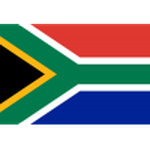
The South Africa national soccer team represents South Africa in men's international soccer and is run by the South African Football Association, the governing body for soccer in South Africa. Nicknamed Bafana Bafana (lit. "Young Men" in Zulu), the team plays at various stadiums around the country. The team, a member of both FIFA and the Confederation of African Football (CAF), is one of the most well-supported national sides in Africa, and are recognised by their traditional green and gold kits.
Having played their first match in 1906, South Africa returned to the world stage in 1992, after sixteen years of being banned from FIFA, and forty years of effective suspension due to the apartheid system. South Africa have qualified for the FIFA World Cup four times: 1998, 2002 and 2026, and qualifying as hosts of the 2010 tournament, becoming the first African nation to do so. Despite defeating France 2–1 in their final game of the group stage, they failed to progress from the first round of the tournament, becoming the first host nation in the history of the FIFA World Cup to exit in the group stage, followed by Qatar in 2022. As of October 2026, the team is ranked 48th in FIFA International Rankings.
South Africa's most significant achievement came in 1996 when they hosted and won the Africa Cup of Nations (AFCON). They reached the final again in 1998 but were defeated by Egypt. Later in 2000, they earned a bronze medal (third place) by defeating Tunisia (2–2 a.e.t, 4–3 on penalties) and in 2023 earned another bronze medal (third place) by defeating the Democratic Republic of the Congo (0–0 a.e.t; 6–5 on penalties).
Leer toda la historia
Pre-1992
Football first arrived in South Africa through colonialism in the late nineteenth century, as the game was popular among British soldiers. From the earliest days of the sport in South Africa until the end of apartheid, organised soccer was affected by the country's system of racial segregation. The all-white Football Association of South Africa (FASA) was formed in 1892, while the South African Indian Football Association (SAIFA), the South African Bantu Football Association (SABFA) and the South African Black Football Association (SACFA) were founded in 1903, 1933 and 1936 respectively.
In 1903 the SAFA re-affiliated with the English Football Association after the Second Boer War between the British Empire and the Boer state. There was a plan to play a tournament held in Argentina, with South Africa and Fulham as guest teams, but it was not carried out. Nevertheless, South Africa traveled to South America in 1906 to play a series of friendly matches there.
South Africa played a total of 12 matches in South America, winning 11 with 60 goals scored and only 7 conceded. Opponents included Belgrano A.C., the Argentina national team, a combined Liga Rosarina, Estudiantes (BA) and Quilmes. The only team that defeated South Africa was Argentina's Alumni 1–0 at Sociedad Sportiva stadium in Buenos Aires, on 24 June, although the South Africans would take revenge on 22 July, defeating them 2–0. The players were exclusively white, civil servants, government employees, bankers and civil engineers. Seven of the 15 players were born in South Africa and 8 originated from England and Scotland.
South Africa was one of four African nations to attend FIFA's 1953 congress, at which the four demanded, and won, representation on the FIFA executive committee. Thus the four nations (South Africa, Ethiopia, Egypt and Sudan) founded the Confederation of African Football in 1956, and the South African representative, Fred Fell, sat at the first meeting as a founding member. It soon became clear however that South Africa's constitution prohibited racially mixed teams from competitive sport, and so they could only send either an all-black side or an all-white side to the planned 1957 African Cup of Nations. This was unacceptable to the other members of the Confederation, and South Africa was disqualified from the competition, however, some sources say that they withdrew voluntarily.
At the second CAF conference in 1958, South Africa were formally expelled from CAF. The all-white FASA were admitted to FIFA in the same year, but in August 1960 it was given an ultimatum of one year to fall in line with the non-discriminatory regulations of FIFA. On 26 September 1961 at the annual FIFA conference, the South African association was formally suspended from FIFA. Sir Stanley Rous, president of The Football Association of England and a champion of South Africa's FIFA membership, was elected FIFA President a few days later. Rous was adamant that sport, and FIFA in particular, should not embroil itself in political matters and against fierce opposition, he continued to resist attempts to expel South Africa from FIFA. The suspension was lifted in January 1963 after a visit to South Africa by Rous in order to investigate the state of soccer in the country.
Rous declared that if the suspension were not lifted, soccer there would be discontinued, possibly to the point of no recovery. The next annual conference of FIFA in October 1964 took place in Tokyo and was attended by a larger contingent of representatives from African and Asian associations and here the suspension of South Africa's membership was re-imposed. In 1976, after the Soweto uprising, they were formally expelled from FIFA.
In 1991, when the apartheid system was beginning to be demolished, a new multi-racial South African Football Association was formed, and admitted to FIFA – and thus finally allowing South Africa to enter the qualifying stages for subsequent World Cups.
1992–2000
After spending nearly two decades in international isolation, the South African national team played its first game on 7 July 1992, beating Cameroon 1–0 at Kings Park in Durban.
The team entered the 1994 Cup of Nations qualifiers and was placed in Group 5, along with Mauritius, Zambia and Zimbabwe. They won one game, away to Mauritius, and drew with Mauritius and Zimbabwe at home. The team finished third in the group and failed to qualify.
For the 1994 FIFA World Cup qualifiers South Africa was placed in Group D, along with Congo, Libya and Nigeria. Libya withdrew from the qualifiers. South Africa finished second in the group, and failed to qualify for the next stage of qualifying.
In 1996, a mere five years after readmission, South Africa achieved their finest moment when they hosted and won the 1996 African Cup of Nations, in the process of reaching 16th in the FIFA rankings.
Seguir leyendo en Wikipedia →
Texto de Wikipedia, licencia CC BY-SA 4.0 (English)
Plantilla
| # | Porteros | PJ | Goles |
|---|---|---|---|
| 1 | Christen Swart Kaylin | ||
| 16 | A. Dlamini | ||
| 21 | K. Moletsane |
| # | Defensas | PJ | Goles |
|---|---|---|---|
| 2 | Lebogang Ramalepe | ||
| 3 | B. Gamede | ||
| 4 | L. Mhlongo | ||
| 5 | F. Magama | ||
| 12 | A. Hadebe | ||
| 13 | B. Mbane | ||
| 15 | R. Jane | ||
| 24 | A. Maponya | ||
| 25 | K. Pila |
| # | Centrocampistas | PJ | Goles |
|---|---|---|---|
| 6 | S. Cesane | ||
| 7 | K. Dhlamini | ||
| 8 | H. Magaia | ||
| 14 | Nonhlanhla Mthandi | ||
| 18 | S. Holweni | ||
| 19 | Alexa Ludwig Isabella | ||
| 20 | R. Moodaly | ||
| 22 | A. Motau |
| # | Delanteros | PJ | Goles |
|---|---|---|---|
| 9 | G. Salgado | ||
| 10 | L. Motlhalo | ||
| 11 | T. Kgatlana | ||
| 17 | Ronnel Donnelly | ||
| 23 | N. Majiya | ||
| 26 | Zoe October |