Histoire
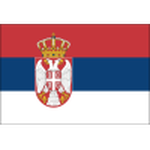
The Serbia national football team (Serbian Cyrillic: Фудбалска репрезентација Србије, romanized: Fudbalska reprezentacija Srbije) represents Serbia in men's international football competition. It is controlled by the Football Association of Serbia, the governing body for football in Serbia.
After the breakup of SFR Yugoslavia and its football team in 1992 Serbia was represented (alongside Montenegro) within the new FR Yugoslavia national football team. Despite qualifying for Euro 1992 the team was banned from participating in the tournament due to international sanctions, with the ruling also enforced for 1994 World Cup and Euro 1996 qualifiers. The national team played its first friendly in December 1994, and with the easing of sanctions the generation of the 1990s eventually participated at the 1998 World Cup, reaching the round of 16, and the quarter-finals at Euro 2000. The team played in the 2006, 2010, 2018 and 2022 FIFA World Cups, but failed to progress past the group stage on each occasion.
Between February 2003 and June 2006, Serbia participated as the Serbia and Montenegro national football team due to the countries' name change. Following a 2006 referendum Montenegro declared its independence, leading to separate football federations which resulted in the team's final renaming and establishment as the Serbia national football team. Serbia is considered by FIFA and UEFA to be the official successor team of FR Yugoslavia/Serbia and Montenegro national football teams, as well as the Kingdom of Yugoslavia/SFR Yugoslavia team.
Lire toute l'histoire
Serbia within Yugoslavia (1920–1992)
The Football Federation of what was then the Kingdom of Serbs, Croats and Slovenes (later Yugoslavia) was founded in Zagreb in 1919 under the name Jugoslavenski nogometni savez (Yugoslavian Football Association). Jovan Ružić was the first Serb to represent the national team in its international debut match, a 7–0 drubbing by Czechoslovakia at the 1920 Olympic Games in Antwerp, Belgium.
In 1921, the Belgrade Football Subassociation organized a friendly match between the France national football team and a Belgrade XI, dubbed the "Serbian representatives". The team featured footballers from SK Jugoslavija and BSK, two of the Serbian clubs of the interwar period. The French delegation was on a four-game tour of Yugoslavia with the last exhibition game being played in Belgrade's SK Jugoslavija Stadium on 3 July. Prince Regent Aleksandar I and FIFA President Jules Rimet were in attendance as the visitors triumphed 3–0.
In the lead-up to the 1930 World Cup, a dispute regarding the relocation of the FAs headquarters from Zagreb to the capital Belgrade erupted, culminating in a boycott by the Zagreb Subassociation which disallowed its members to participate in the upcoming tournament. The de facto Serbian team led by coach Boško Simonović, composed largely of players from Belgrade's BSK, SK Jugoslavija and BASK, reached the semi-final, losing to hosts and eventual winners Uruguay 6–1. The royal interbellum era featured footballers such as Blagoje Marjanović, Aleksandar Tirnanić, Milorad Arsenijević, Đorđe Vujadinović, Branislav Sekulić and Milutin Ivković. Due to the dismemberment of Yugoslavia during World War II the football federation and national team ceased activities but reformed following the end of hostilities.
In 1945 Svetislav Glišović led the first unofficial national team representing the Federal State of Serbia in a tournament held to mark the end of World War II. The Serbian team encompassing the newly established Red Star squad won its first game by beating FS Montenegro 2–1, FS Croatia 3–1 in the semi-final, then proceeding to win the tournament against the Yugoslav People's Army team 1–0 in Belgrade.
The reconstituted Yugoslavia reached the UEFA European Championship finals in 1960 and 1968, and finished fourth place at the 1962 FIFA World Cup. During its existence Serbian footballers would continually play a major role in the Yugoslavia national team throughout the socialist era, with the likes of Rajko Mitić, Branko Stanković, Vladimir Beara, Vujadin Boškov, Todor Veselinović, Miloš Milutinović, Borivoje Kostić, Milan Galić, Vladimir Durković, Velibor Vasović, Dragan Džajić, Jovan Aćimović, Dušan Bajević, Vladimir Petrović and others until the states disintegrated in the 1990s. The national team of SFR Yugoslavia played its last game on 25 March 1992, losing 2–0 to the Netherlands.
FR Yugoslavia/Serbia & Montenegro era (1992–2006)
While the Federal Republic of Yugoslavia, consisting of Serbia and Montenegro, was formed on 27 April 1992, its teams were banned from all international sporting events, including the national football team as a result of U.N. sanctions stemming from the conflict in Yugoslavia. Consequently, the national team did not play its first game as a new country before 23 December 1994, a friendly match played in Porto Alegre and in which Brazil won 2–0. This was the first ever team composed of Serbian and Montenegrin players exclusively, while Slobodan Santrač, a former Yugoslavia national team player, was named the team's first ever manager. The next game was played three days later, this time in Buenos Aires, resulting in a 1–0 loss to Argentina.
Due to international sanctions, the team could not participate in 1994 World Cup qualifying nor the Euro 1996 qualifying process.
1998 World Cup
As FR Yugoslavia joined FIFA and UEFA in 1994, the team was available to participate in the 1998 World Cup qualifiers. Slobodan Santrač was appointed manager for the team. In the qualifiers, Yugoslavia was drawn in Group 6 with Euro 1996 runners-up Czech Republic, Slovakia, Spain, Faroe Islands and Malta. With 23 points, Yugoslavia ended up in second place behind Spain. Yugoslavia qualified for the play-off in which they were drawn to play against Hungary. Winning 12–1 on aggregate, Yugoslavia qualified for the World Cup.
The draw put the team in Group F alongside Germany, the United States, and Iran. Yugoslavia won its first game 1–0 against Iran thanks to a goal from defender Siniša Mihajlović. The next game was a draw for Yugoslavia; after leading Germany 2–0, a free kick from Michael Tarnat deflected off Mihajlović and into the goal, then Oliver Bierhoff equalised it at 2–2 at the 80th minute. Yugoslavia responded in the next game against the United States and won 1–0 due to a goal in the fourth minute by Slobodan Komljenović. Yugoslavia finished second in the group behind Germany on goal difference.
Lire la suite sur Wikipédia →
Texte de Wikipédia, licence CC BY-SA 4.0 (English)
Effectif
| # | Gardiens | Matchs | Buts |
|---|---|---|---|
| 1 | Luka Lijeskic | 0 | 0 |
| 1 | Djordje Petrovic | 5 | 0 |
| 12 | Veljko Ilic | 0 | 0 |
| 12 | Filip Stankovic | 0 | 0 |
| 23 | Vanja Milinkovic-Savic | 0 | 0 |
| # | Défenseurs | Matchs | Buts |
|---|---|---|---|
| 2 | Kosta Nedeljkovic | 2 | 0 |
| 3 | Strahinja Pavlovic | 7 | 0 |
| 4 | Ognjen Mimovic | 2 | 0 |
| 5 | Mirko Milikic | 0 | 0 |
| 13 | Stefan Bukinac | 0 | 0 |
| 13 | Nikola Simic | 0 | 0 |
| 14 | Vukasin Djurdjevic | 0 | 0 |
| 15 | Srdjan Babic | 0 | 0 |
| 16 | Strahinja Erakovic | 4 | 0 |
| 17 | Aleksa Terzic | 3 | 0 |
| 21 | Adem Avdic | 0 | 0 |
| Petar Petrovic | 0 | 0 |
| # | Milieux | Matchs | Buts |
|---|---|---|---|
| 4 | Vanja Dragojevic | 0 | 0 |
| 5 | Nemanja Maksimovic | 5 | 0 |
| 6 | Nemanja Gudelj | 5 | 0 |
| 7 | Aleksandar Stankovic | 4 | 1 |
| 8 | Njegos Petrovic | 0 | 0 |
| 10 | Andrija Maksimovic | 1 | 0 |
| 10 | Dusan Tadic | 0 | 0 |
| 11 | Filip Kostic | 6 | 0 |
| 14 | Andrija Zivkovic | 6 | 0 |
| 19 | Stefan Dzodic | 0 | 0 |
| 20 | Vasilije Kostov | 1 | 0 |
| 20 | Sergej Milinkovic-Savic | 0 | 0 |
| 21 | Lazar Samardzic | 7 | 0 |
| 22 | Sasa Lukic | 5 | 0 |
| 22 | Petar Stanic | 0 | 0 |
| # | Attaquants | Matchs | Buts |
|---|---|---|---|
| 2 | Petar Sukacev | 0 | 0 |
| 8 | Luka Jovic | 6 | 0 |
| 9 | Dejan Joveljic | 0 | 0 |
| 11 | Vladimir Lucic | 0 | 0 |
| 17 | Jovan Milosevic | 1 | 0 |
| 18 | Mihajlo Cvetkovic | 0 | 0 |
| 18 | Mihailo Ivanovic | 0 | 0 |
| 18 | Nikola Stulic | 0 | 0 |
| 19 | Lazar Randjelovic | 0 | 0 |
| Veljko Birmancevic | 1 | 0 |